AI & Data
Build Once and Query Anywhere with Airbyte's Data Lake Connector
Build AI-Ready Data Lakes with Airbyte + Iceberg
Data engineers today aren’t just moving data — they’re building intelligent, scalable, and AI-ready systems. That’s why we’re excited to introduce our S3 Data Lake destination, built on top of Apache Iceberg. Whether you’re syncing structured sources like Postgres, ingesting semi-structured files from S3, or enabling large-scale AI workflows with embedded data, this connector gives you the tooling to do it all. With built-in field-level mappings for hashing, encryption, and renaming, and Iceberg’s native support for schema evolution and versioned table management, you can go from messy source data to clean, queryable lakes with minimal effort — and maximum flexibility
From ETL to EtLT: The Evolution of Data Engineering
The data engineering world has undergone a fundamental shift. Traditional ETL (Extract-Transform-Load) pipelines, once dominant, have largely evolved into an EtLT model — Extract, light Transform, Load, then Transform. This shift isn't just semantics — it reflects a better way to deal with today’s massive data volumes and AI workloads:
- Preserve raw data for reuse
- Minimize data movement (and associated costs)
- Decouple transformations from ingestion
- Empower analysts and AI systems to define context-specific logic
The Real Costs of Moving Data
As Airbyte’s VP of Engineering shared at move(data), moving large datasets across systems is costly and risky:
- Network costs scale fast at petabyte volumes
- Pre-load transformations create brittle pipelines
- Source APIs often limit throughput
- Schema drift can bring pipelines down mid-sync
By adopting EtLT and modern lakehouse formats like Iceberg, you or your team could reduce complexity, costs, and risk!
How Airbyte's S3 Data Lake Connector Transforms the Iceberg Experience
While Apache Iceberg offers powerful capabilities on its own, Airbyte's S3 Data Lake connector transforms it into an enterprise-ready solution that's accessible to data teams of all sizes. Our implementation isn't just a pass-through to Iceberg – it's a comprehensive system that manages the entire data journey.
Beyond Basic Connectivity: Airbyte's Implementation
Airbyte's S3 Data Lake connector delivers several critical capabilities:
-
Branching Strategy for Truncate Syncs
- During truncate syncs, refreshed data is written to a staging branch (
airbyte_staging) before atomically fast-forwarding the main branch. This follows Iceberg best practices, ensuring consistent reads during syncs and minimizing operational disruption.
- During truncate syncs, refreshed data is written to a staging branch (
-
Comprehensive Catalog Support - You can choose from multiple catalog types to suit your environment:
- AWS Glue for deep AWS integrations
- Nessie for Git-style table versioning
- REST Catalog for flexibility with custom tools
-
Automated Type Mapping - Airbyte automatically maps between its internal schema and Iceberg’s table structure:
- Boolean → Boolean
- Integer → Long
- Number → Double
- Date/Time with timezone support
- Nested fields → JSON serialization
-
Schema Evolution Handling - As source schemas evolve, Airbyte updates the Iceberg table with minimal friction:
- Add/remove columns safely
- Widen column types
- Gracefully handle primary key changes
-
Built-In Field Mappings - Airbyte’s native Mappings feature integrates directly with Iceberg:
- Hash PII fields (SHA-256, MD5, etc.)
- Encrypt data using RSA
- Rename fields for clarity
- Filter records inline during ingestion
These capabilities transform Iceberg from a powerful-but-complex table format into a complete solution for modern data architectures.
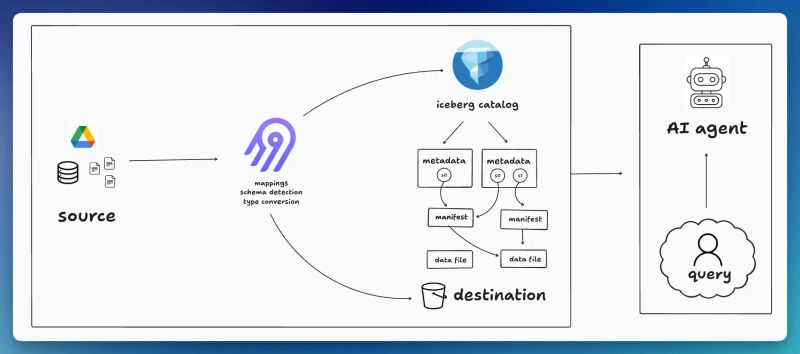
As you can see in the diagram below, Airbyte is acting as a bridge between raw source data and the data lake built on Iceberg:
- Source: This can range from structured CSVs, JSON files, or any semi-structured export too.
- Airbyte Connector: This is where the schema detection, type conversion, and mappings come to play.
- Destination: The transformed data is written to Iceberg, where the metadata (snapshots, manifests, and schema files) is automatically generated and tracked in the connected Iceberg catalog (AWS Glue, Nessie, etc).
- AI Agent or User: Once the data is ingested, it becomes queryable via SQL engines or available to AI agents for powering applications like search, recommendations, or RAG. The AI agent can then access the latest version of the data directly via the catalog.
Iceberg's snapshot-based approach enables efficient access to historical data states. This means you can:
- Query data as it existed at specific points in time
- Recover from erroneous updates when needed
- Compare results across different versions
These capabilities are implemented efficiently through Iceberg's metadata layer, which references existing data files rather than duplicating them. For data engineers, this means enhanced reliability and audit capabilities without storage overhead.
Unified Storage for Modern Data Workflows
With support for structured and semi-structured formats, Airbyte's S3 Data Lake connector allows teams to consolidate diverse data sources into a single Iceberg-backed lake. Whether you’re ingesting from Postgres, MySQL, Google Sheets, or custom APIs, the connector takes care of storage formatting and table lifecycle management.
This unified storage layer enables you to write once and query anywhere — using tools like Trino, Spark, or Snowflake without needing separate ingestion logic for each.
AI Agents and Data: Building for What’s Next
As AI agents become first-class data consumers, the expectations for infrastructure are shifting. These systems demand:
- Consistent schemas
- Rich metadata and lineage
- Minimal latency between ingestion and access
- Version control for safe experimentation
Iceberg provides the foundation. Airbyte makes it usable out of the box — especially for teams building retrieval-augmented generation (RAG), analytics pipelines, or embedded AI workflows.
Technical Benefits of the Iceberg Approach
Airbyte's S3 Data Lake connector with Iceberg enables several key technical capabilities for modern data workflows:
- Unified storage for diverse data types
- Multi-engine query support (Spark, Presto, Trino, Snowflake)
- Schema evolution without data rewrites
- Reliable data access for both traditional analytics and AI applications
This combination of features eliminates many of the traditional trade-offs between flexibility, performance, and governance.
Conclusion: Build Once, Query Anywhere
By combining Airbyte's powerful sync engine with Iceberg’s modern table format, teams can simplify their pipelines without sacrificing performance or flexibility. You don’t have to choose between streaming ingest, schema evolution, and versioned storage — now you get it all in one place!
Whether you’re migrating legacy ETL, scaling AI pipelines, or just looking for better table lifecycle management, Airbyte's S3 Data Lake destination is ready to support your next phase of data infrastructure.
Ready to get started? Try Airbyte's S3 Data Lake connector today →
Check out our Webinar given by the Developer Relations team on how to build AI apps with our our Iceberg connector!